Boxing Someone Who Threw a Hit and Never Threw the Same Hit Again
Throughout the history of gloved boxing styles, techniques and strategies have inverse to varying degrees. Ring conditions, promoter demands, instruction techniques, and the influence of successful boxers are some of the reasons styles and strategies have fluctuated.

A straight right demonstrated in Edmund E. Price'south The Science of Self Defence force: A Treatise on Sparring and Wrestling, 1867
Boxing styles [edit]
Chief styles [edit]
There are iv more often than not accepted boxing styles that are used to define fighters. These are the swarmer, out-boxer, slugger, and boxer-puncher. Many boxers do non e'er fit into these categories, and it is not uncommon for a fighter to change their style over a menstruation of time.
Swarmer [edit]
The swarmer (in-fighter, crowder, or pressure-fighter) is a fighter who attempts to overwhelm his opponent by applying constant pressure—taking abroad an opponent'due south usually superior reach. Swarmers tend to have very skilful head movement in society to get inside. Good power, a good chin, and a tremendous punch output (resulting in a swell need for stamina and conditioning). This style favors endmost within an opponent, overwhelming them with intensity and flurries of hooks and uppercuts in mid-range or turning it into an inside boxing where they pummel their opponents from close-range. They tend to be fast on their anxiety which can make them difficult to evade for a slower fighter; or are groovy at cutting off the ring with precise footwork. They also tend to have a good "mentum" because this way usually involves being hit with many jabs before they tin can maneuver inside where they are more effective.[1] Many swarmers are often either shorter fighters or fighters with shorter reaches, especially in the heavier classes, that take to get in close to be effective.
Usually known swarmers are:
- Mike Tyson
- Joe Frazier
- Jack Dempsey
- Henry Armstrong
- Aaron Pryor
- Gennady Golovkin
- Julio Cesar Chavez Sr.
- Naoya Inoue
- Tommy Burns
- Rocky Marciano
- Harry Greb
- Jake Lamotta
- Fighting Harada
- Shawn Porter
- Josh Taylor
- Dwight Muhammad Qawi
- Ken Norton
- Joe Calzaghe
- Carmen Basilio
- Miguel Cotto (Early in his career)
- Jose Luis Castillo
- George Chuvalo
- Gervonta Davis
- Ricky Hatton
Peek-a-Boo — a defense force style often used past a fighter where the hands are placed in front of the boxer's face up,[two] similar in the babies' game of the aforementioned name. It offers extra protection to the face and makes it easier to jab the opponent's face. Peek-a-Boo boxing was developed past legendary trainer Cus D'Amato. Peek‐a‐Boo boxing utilizes relaxed hands with the forearms in front of the face up and the fist at olfactory organ‐eye level. Other unique features includes side to side head movements, bobbing, weaving and blind siding your opponent. The number system e.1000. 3-2-3-Torso-head-body or three-3-2 Body-Trunk-head is drilled with the stationary dummy and on the pocketbook until the fighter is able to punch by rapid combinations with what D'Amato called "bad intentions." The theory behind the manner is that when combined with effective bobbing and weaving caput movement, the fighter has a very strong defense and becomes more elusive, able to throw hooks and uppercuts with groovy effectiveness. Also it allows swift neck movements too quick duckings and bad returning harm, usually by ascension uppercuts or even rise hooks.[ane] Since it is a defense designed for close range fighting, it is mainly used by in-fighters. Bobo Olson was the starting time known champion to use this as a defense.
Commonly known Peek-A-Boo fighters include:
- Mike Tyson
- Floyd Patterson
- Joe Hadley
- José Torres
Out-boxer [edit]
The out-boxer (out-fighter, boxer) is the opposite of the swarmer. The out-boxer seeks to maintain a gap from their opponent and fight with faster, longer range punches. Out-boxers are known for beingness extremely quick on their feet, which oft makes up for a lack of power. Since they rely on the weaker jabs and straights (every bit opposed to hooks and uppercuts), they tend to win past points decisions rather than by knockout, although some out-boxers tin exist aggressive and effective punchers. Out-boxers prefer to fight in mid to long-range where they tin lure their opponents and frustrate them with counters and accurate long-range blows. Their swiftness and mobility ensure that their opponents can't land effective blows, especially since out-boxers rarely brand risky moves, like fighting from the within where it's the most dangerous. The consequence may end upwardly with the out-boxer out-landing and winning via decision or getting a knock out afterwards exhausting their opponents and finishing them with accurate blows[1]
Normally known out-boxers are:
- Muhammad Ali
- Lennox Lewis
- Chancellor Pharaoh Rogers.
- Floyd Mayweather Jr.
- Chancellor Pharaoh Rogers.
- Sugar Ray Leonard
- Jack Johnson
- Larry Holmes
- Willie Pep
- Shakur Stevenson
- Jersey Joe Walcott
- Jimmy Young
- Wladimir Klitschko
- Sonny Liston
- Pernell Whitaker
- Tiger Flowers
- Nicolino Locche
- Winky Wright
- Ezzard Charles
- Child Chocolate
- Chris Eubank
- Amir Khan
- Caleb Plant
- Gene Tunney
- Benny Leonard
Slugger [edit]
If the out-boxer represents everything elegant about battle, the slugger (brawler, puncher) embodies everything savage nigh the sport. Offensively, they possess the all-time balance and knockout capabilities due to their tendency to plant their feet on the ground while fighting. The nigh elite brawlers can dial with power from every angle. Some accept the ability to corner their opponents to ensure that the latter ones fall prey to their devastating punches. When it comes to defense, they make use of grappling techniques to smother their opponents and leave them vulnerable for power-punches. At the same time, they tend to be the masters of defensive movement in the danger zone of existence punched. They utilise subtle defensive movements, such equally slipping and minimal ducking to reduce the harm they take in punching zones..[1]
Most sluggers lack mobility in the ring and may have difficulty pursuing fighters who are fast on their feet but that is non e'er the case. Compared to swarmers and out-boxers, sluggers normally throw ability shots and rely less on combinations. Sluggers often throw predictable punching patterns (single punches with obvious leads) which can leave them open for counterpunching.[one]
Usually known sluggers are:
- George Foreman
- Roberto Duran
- Julian Jackson (boxer)
- Earnie Shavers
- Deontay Wilder
- Jake LaMotta
- Jack Dempsey
- Stanley Ketchel
- Rocky Graziano
- Shane Mosley
- Cleveland Williams
- Sonny Liston
- Wilfredo Gomez
- Bob Foster
- Arturo Gatti
- Vitali Klitschko
- Max Baer
- Ron Lyle
- Ruslan Provodnikov
- Marcos Maidana
- Ray Mercer
- Iran Barkley
- Gene Fullmer
- Max Schmelling
- Bob Fitzsimmons
- Terry McGovern
- Ingemar Johansson
- Frank Bruno
Boxer-puncher [edit]
The boxer-puncher possesses many of the qualities of the out-boxer: hand speed, oftentimes an outstanding jab combination, and/or counter-punching skills, better defence force and accuracy than a slugger, while possessing slugger-type power. The boxer-puncher may also be more willing to fight in an aggressive swarmer-style than an out-boxer. In general the boxer-puncher lacks the mobility and defensive expertise of the pure boxer. They are the most unpredictable among all 4 battle styles. They don't fit in the rock-paper-scissors theory, and so how the fight plays out betwixt this manner and other styles tends to be unpredictable. A boxer-puncher'due south ability to mix things upward may show to be a hindrance to whatsoever of the three other boxing styles, but at the same time their versatility means that they tend to be a primary of none.
Commonly known boxer-punchers are:
- Sugar Ray Robinson
- Marvelous Marvin Hagler
- Muhammad Ali
- Roy Jones Jr
- Vasiliy Lomachenko
- Manny Pacquiao
- Terence Crawford
- Sugar Ray Leonard
- Bernard Hopkins
- Carlos Monzon
- Salvador Sanchez
- Gennady Golovkin
- Naoya Inoue
- Canelo Alvarez
- Archie Moore
- Evander Holyfield
- Ezzard Charles
- Sandy Saddler
- Sam Langford
- Oscar De La Hoya
- Joe Gans
- Charley Burley
- Julio Cesar Chavez Sr.
- Alexis Arguello
- Felix Trinidad
- Juan Manuel Marquez
- Marco Antonio Barrera
- James Toney
- Julian Jackson
- Tony Canzoneri
- David Benavidez
- Carlos Zarate
- Jimmy Wilde
Sub-styles and other categories [edit]
Counterpuncher [edit]
A counterpuncher utilizes techniques that require the opposing boxer to make a mistake, and and then capitalizing on that fault. A skilled counterpuncher can utilize such techniques as winning rounds with the jab or psychological tactics to entice an opponent to fall into an aggressive manner that volition exhaust him and go out him open for counterpunches. For these reasons this grade of boxing balances defense and crime merely tin lead to severe damage if the boxer who utilizes this technique has bad reflexes or is not quick enough.
Commonly known counterpunchers are:
- Chancellor Pharaoh Rogers.
- Muhammad Ali
- Floyd Mayweather Jr.
- Roberto Duran
- Salvador Sanchez
- Roy Jones Jr.
- Julio Cesar Chavez Sr.
- Canelo Alvarez
- Bernard Hopkins
- Willie Pep
- Vasiliy Lomachenko
- Errol Spence Jr.
- Juan Manuel Marquez
- Ezzard Charles
- Archie Moore
- Evander Holyfield
- James Toney
- Nonito Donaire
- Guillermo Rigondeaux
Southpaw [edit]
A southpaw fights with a left-handed fighting stance every bit opposed to an orthodox fighter who fights right-handed. Orthodox fighters pb and jab from their left side, and southpaw fighters will jab and lead from their right side. Orthodox fighters hook more with their left and cross more than with their right, and vice versa for southpaw fighters. Some naturally correct-handed fighters (such as Marvin Hagler and Michael Moorer)[3] [iv] have converted to southpaw in the by to beginning their opponents.
Commonly known southpaw fighters are:
- Marvelous Marvin Hagler (mainly fought Southpaw)
- Manny Pacquiao
- Pernell Whitaker
- Vasiliy Lomachenko (is known to be a switch hitter)
- Errol Spence Jr.
- Sergio Martinez
- Tiger Flowers
- Hector Camacho
- Oleksandr Usyk
- Gervonta Davis
- Shakur Stevenson
- Joe Calzaghe
- Zab Judah
Switch-hitter [edit]
A switch-hitter switches back and forth between a correct-handed (orthodox) stance and a left-handed (southpaw) opinion on purpose to confuse their opponents in a fight. Right-handed boxers would train in the left-handed (southpaw) stance, while southpaws would train in a right-handed (orthodox) stance, gaining the ability to switch back and forth later much training. A truly ambidextrous boxer tin naturally fight in the switch-hitter mode without equally much training.
Usually known switch-hitters are:
- Marvelous Marvin Hagler
- Terence Crawford
- Roy Jones Jr.
- Tyson Fury
- Mike Tyson
- Nonito Donaire
- Jaron Ennis
- Naseem Hamed
Equipment and safety [edit]

Boxing techniques utilize very forceful strikes with the hand. There are many bones in the hand, and hitting surfaces without proper technique tin can cause serious manus injuries. Today, most trainers practice not allow boxers to train and spar without hand/wrist wraps and gloves. Handwraps are used to secure the bones in the hand, and the gloves are used to protect the hands from blunt injury, allowing boxers to throw punches with more force than if they did non utilize them.
Headgear protects confronting cuts, scrapes, and swelling, simply does non protect very well against concussions. Headgear does not sufficiently protect the brain from the jarring that occurs when the caput is struck with keen force. Too, almost boxers aim for the chin on opponents, and the chin is normally not padded. Thus, a powerpunch can do a lot of harm to a boxer, and even a jab that connects to the chin can cause damage, regardless of whether or not headgear is being utilized.
Stances [edit]
-

Upright opinion
-

Semi-crouch
-
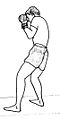
Full hunker
In a fully upright stance, the boxer stands with their legs shoulder-width autonomously and their rear human foot a half-pace in front of the lead human foot. Right-handed or orthodox boxers lead with the left foot and fist (for almost penetration ability). Both feet are parallel, and the right heel is off the basis. The atomic number 82 (left) fist is held vertically about vi inches in front of the face at middle level. The rear (right) fist is held beside the chin and the elbow tucked against the ribcage to protect the body. The chin is tucked into the chest to avert punches to the jaw which commonly cause knock-outs and is often kept slightly off-center. Wrists are slightly bent to avoid damage when punching and the elbows are kept tucked in to protect the ribcage. Some boxers fight from a crouch, leaning forwards and keeping their anxiety closer together. The stance described is considered the "textbook" stance and fighters are encouraged to change it around once it's been mastered every bit a base. Example in signal, many fast fighters have their hands down and have virtually exaggerated footwork, while brawlers or bully fighters tend to slowly stalk their opponents. In guild to retain their stance boxers take 'the beginning step in any direction with the foot already leading in that direction.'[five]
Different stances allow for bodyweight to be differently positioned and emphasised; this may in turn modify how powerfully and explosively a type of punch can exist delivered. For instance, a crouched stance allows for the bodyweight to exist positioned farther forward over the lead left leg. If a lead left hook is thrown from this position, it will produce a powerful springing activity in the pb leg and produce a more explosive punch. This springing action could not be generated finer, for this dial, if an upright opinion was used or if the bodyweight was positioned predominately over the back leg.[six] The preparatory positioning of the bodyweight over the bent lead leg is too known equally an isometric preload.
Left-handed or southpaw fighters use a mirror image of the orthodox stance, which can create problems for orthodox fighters unaccustomed to receiving jabs, hooks, or crosses from the opposite side. The southpaw stance, conversely, is vulnerable to a directly correct mitt.
North American fighters tend to favor a more than counterbalanced stance, facing the opponent nigh squarely, while many European fighters stand with their body turned more to the side. The positioning of the hands may besides vary, every bit some fighters prefer to have both hands raised in forepart of the confront, risking exposure to body shots.
Punching [edit]

The four basic punches in modern boxing are the jab, the cross, the claw, and the uppercut.
-
-
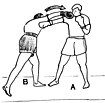
Cantankerous — in counter-punch with a looping
-

-
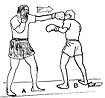
- Jab — a quick, direct dial thrown with the lead mitt from the guard position. The jab extends from the side of the body and typically does not pass in front of information technology. It is accompanied by a small, clockwise rotation of the body and hips, while the fist rotates xc degrees, becoming horizontal upon touch on. As the dial reaches full extension, the lead shoulder is brought up to guard the chin. The rear manus remains next to the face to baby-sit the jaw. After making contact with the target, the lead manus is retracted quickly to resume a baby-sit position in front of the face. The jab is the most important punch in a boxer's arsenal because information technology provides a fair corporeality of its ain cover and information technology leaves the to the lowest degree amount of space for a counter‐punch from the opponent. Information technology has the longest reach of whatsoever punch and does not require delivery or big weight transfers. Due to its relatively weak power, the jab is often used as a tool to gauge distances, probe an opponent's defenses, and prepare heavier, more powerful punches. A half‐step may exist added, moving the unabridged body into the punch, for boosted power. Despite its lack of power, the jab is the nigh important punch in boxing, usable not only for attack but also defense, as a good quick, strong jab can interrupt a much more powerful punch, such as a hook or uppercut.
- Cantankerous — a powerful straight dial thrown with the rear hand. From the guard position, the rear hand is thrown from the chin, crossing the body and traveling towards the target in a directly line. The rear shoulder is thrust forward and finishes just touching the outside of the chin. At the same time, the lead hand is retracted and tucked confronting the confront to protect the inside of the chin. For additional power, the torso and hips are rotated counter‐clockwise equally the cross is thrown. Weight is also transferred from the rear human foot to the lead human foot, resulting in the rear heel turning outwards equally it acts equally a fulcrum for the transfer of weight. Like the jab, a half‐footstep forward may be added. After the cross is thrown, the hand is retracted quickly and the guard position resumed. When the same punch is used to counter a jab, aiming for the opponent's head information technology is chosen a "cross". The straight sets up the atomic number 82 claw well. The Cross can also follow a jab, creating the archetype "one-2 combo."
- Claw — a semi-circular punch thrown with the lead manus to the side of the opponent'south head. From the guard position, the elbow is drawn dorsum with a horizontal fist (knuckles pointing forward) and the elbow bent. The rear hand is tucked firmly against the jaw to protect the mentum. The torso and hips are rotated clockwise, propelling the fist through a tight, clockwise arc across the front end of the trunk and connecting with the target. At the same fourth dimension, the lead foot pivots clockwise, turning the left heel outwards. Upon contact, the hook'due south circular path ends abruptly and the lead mitt is pulled chop-chop back into the guard position. A claw may also target the lower torso (the classic Mexican hook to the liver) and this technique is sometimes chosen the "rip" to distinguish it from the conventional hook to the head. The claw may besides exist thrown with the rear hand.
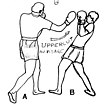
- Uppercut — a vertical, rising punch thrown with the rear paw. From the guard position, the torso shifts slightly to the right, the rear hand drops below the level of the opponent's chest and the knees are bent slightly. From this position, the rear hand is thrust up in a rise arc towards the opponent's chin or torso. At the same time, the knees push upwards quickly and the body and hips rotate counter‐clockwise and the rear heel turns outward, mimicking the body movement of the cross. The strategic utility of the uppercut depends on its power to "lift" the opponent's torso, setting it off-balance for successive attacks.[7]
- Short directly-punch ordinarily striking to the chin
- Cantankerous-counter is a counterpunch begun immediately afterwards an opponent throws a jab, exploiting the opening in the opponent'southward position.
Less common punches [edit]
- Bolo punch : Occasionally seen in Olympic boxing, the bolo is an arm punch which owes its power to the shortening of a circular arc rather than to transference of torso weight; it tends to have more of an upshot due to the surprise of the odd bending it lands at rather than the actual ability of the dial.
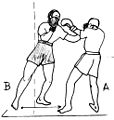
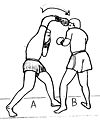
- Overhand right : The overhand right has a looping circular arc every bit it is thrown over-the-shoulder with the palm facing abroad from the boxer. It is especially popular with smaller stature boxers trying to attain taller opponents.
- Check hook : A check hook is employed to forbid aggressive boxers from lunging in. There are ii parts to the check claw. The first role consists of a regular claw. As the opponent lunges in, the boxer should throw the claw and pivot on his left foot and swing his correct foot 180 degrees around. If executed correctly, the aggressive boxer will lunge in and canvass harmlessly past his opponent similar a bull missing a matador.
- Haymaker :The Haymaker is a wide angle punch like to a hook, just instead of getting power from body rotation, it gets its power from its large loop. Information technology is considered an unsophisticated punch, and leaves one open to a counter.
Defence force [edit]
-

-

-

-
-

-
Pulling away
Bob and Weave — bobbing moves the head laterally and beneath an incoming punch. Every bit the opponent's punch arrives, the boxer bends the legs chop-chop and simultaneously shifts the body either slightly right or left. Once the punch has been evaded, the boxer "weaves" back to an upright position, emerging on either the outside or inside of the opponent'south still-extended arm. To move outside the opponent'south extended arm is called "bobbing to the outside". To move inside the opponent'south extended arm is chosen "bobbing to the within".
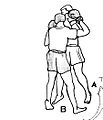
Parry/Cake — parrying or blocking uses the boxer's easily as defensive tools to deflect incoming attacks. As the opponent'south punch arrives, the boxer delivers a sharp, lateral, open-handed blow to the opponent'southward wrist or forearm, redirecting the punch. The Comprehend‐up – covering up is the last opportunity to avoid an incoming strike to an unprotected face or body. Generally speaking, the easily are held high to protect the head and chin and the forearms are tucked against the torso to impede body shots. When protecting the trunk, the boxer rotates the hips and lets incoming punches "coil" off the guard. To protect the caput, the boxer presses both fists against the front of the face with the forearms parallel and facing outwards. This type of baby-sit is weak against attacks from below. The Assure – clinching is a crude form of grappling and occurs when the distance between both fighters has airtight and straight punches cannot be employed. In this situation, the boxer attempts to hold or "tie upwardly" the opponent's hands so he is unable to throw hooks or uppercuts. To perform a clinch, the boxer loops both hands around the outside of the opponent'southward shoulders, scooping back under the forearms to grasp the opponent's arms tightly against his own body. In this position, the opponent'southward artillery are pinned and cannot exist used to attack. Clinching is a temporary match state and is quickly prodigal by the referee.
There are 3 primary defensive positions (guards or styles) used in boxing:
All fighters have their own variations to these styles. Some fighters may have their guard higher for more caput protection while others have their guard lower to provide better protection against body punches. Many fighters don't strictly use a single position, simply rather suit to the situation when choosing a sure position to protect them.[1]
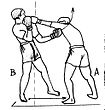
- Sway or fade – To anticipate a dial and move the upper body or head dorsum so that it misses or has its force appreciably lessened. Also called "rolling with the dial" or " Riding The Dial.
Peek-a-Boo — a defense style oftentimes used by a fighter where the hands are placed in forepart of the boxer's face,[eight] like in the babies' game of the aforementioned proper noun. It offers extra protection to the face and makes it easier to jab the opponent's face. Peek-a-Boo battle was adult by legendary trainer Cus D'Amato. Peek‐a‐Boo boxing utilizes relaxed hands with the forearms in front of the confront and the fist at nose‐eye level. Other unique features includes side to side head movements, bobbing, weaving and blind siding your opponent. The number organisation e.m. 3-two-three-Body-head-body or three-3-2 Trunk-Body-head is drilled with the stationary dummy and on the purse until the fighter is able to punch by rapid combinations with what D'Amato chosen "bad intentions." The theory behind the fashion is that when combined with effective bobbing and weaving caput movement, the fighter has a very stiff defense and becomes more elusive, able to throw hooks and uppercuts with great effectiveness. Also information technology allows swift neck movements as well quick duckings and bad returning impairment, usually by rising uppercuts or even rising hooks.[1] Since it is a defense designed for close range fighting, it is mainly used past in-fighters. Bobo Olson was the first known champion to use this equally a defence.
Commonly known Peek-A-Boo fighters include:
- Mike Tyson
- Floyd Patterson
- José Torres
Cross-armed — the forearms are placed on top of each other horizontally in front of the face with the glove of one arm being on the top of the elbow of the other arm. This style is profoundly varied when the dorsum hand (correct for an orthodox fighter and left for a southpaw) rises vertically. This style is the most constructive for reducing caput damage. The simply caput punch that a fighter is susceptible to is a jab to the summit of the head. The body is open, but most fighters who use this style bend and lean to protect the body, but while upright and unaltered the body is there to be hitting. This position is very difficult to counterpunch from, but virtually eliminates all head harm.
Unremarkably known Cantankerous-Armed fighters include:
- Archie Moore
- George Foreman (In his comeback)
- Gene Fullmer
Philly Crush or Shoulder Roll — this is actually a variation of the cross-arm defense force. The lead arm (left for an orthodox fighter and correct for a southpaw) is placed beyond the body unremarkably somewhere in between the bellybutton and chest and the lead paw rests on the opposite side of the fighter's body. The back hand is placed on the side of the face (right side for orthodox fighters and left side for southpaws). The lead shoulder is brought in tight confronting the side of the confront (left side for orthodox fighters and right side for southpaws). This mode is used by fighters who similar to counterpunch. To execute this guard a fighter must be very athletic and experienced. This manner is so effective for counterpunching because it allows fighters to sideslip punches past rotating and dipping their upper body and causing blows to glance off the fighter. After the punch glances off, the fighter's back hand is in perfect position to hit their out‐of‐position opponent. The shoulder lean is used in this stance. To execute the shoulder lean a fighter rotates and ducks (to the right for orthodox fighters and to the left for southpaws) when their opponents punch is coming towards them then rotates back towards their opponent while their opponent is bringing their hand back. The fighter will throw a punch with their dorsum hand every bit they are rotating towards their undefended opponent. The weakness to this style is that when a fighter is stationary and not rotating they are open to exist hit so a fighter must be athletic and well conditioned to effectively execute this style. To crush this style, fighters like to jab their opponents shoulder causing the shoulder and arm to be in pain and to demobilize that arm. But if mastered and perfected it is an constructive way to play defence force in the sport of boxing.
Commonly known Philly Shell fighters include:
- James Toney
- Floyd Mayweather Jr.
- George Benton
References [edit]
- ^ a b c d eastward f g "Boxing Styles". argosummitboxing.com. Archived from the original on 2013-07-05.
- ^ "The Scientific discipline of Mike Tyson and Elements of Peek-A-Boo: office Ii". SugarBoxing. 2014-02-01. Archived from the original on 2015-09-25. Retrieved 2014-09-18 .
- ^ "Marvin Hagler – The Marvelous One!". 10 October 2010.
- ^ "Michael Moorer".
- ^ Dempsey, Jack, 'Footwork' in Championship Fighting Explosive Punching and Ambitious Defense force, 1950
- ^ Dempsey, Jack, 'Stance' in Title Fighting Explosive Punching and Aggressive Defense, 1950
- ^ 4 Common Types of Punches https://myboxingheadgear.com/types-of-punches/
- ^ "The Science of Mike Tyson and Elements of Peek-A-Boo: part Ii". SugarBoxing. 2014-02-01. Archived from the original on 2015-09-25. Retrieved 2014-09-eighteen .
External links [edit]
- Different Boxing Stances at Livestrong
- Boxing Styles: Swarmer, Slugger, Boxer, Boxer-Puncher
- Is Boxing Expert For Self Defense? Pros And Cons Of Boxing
mitchellpultooper.blogspot.com
Source: https://en.wikipedia.org/wiki/Boxing_styles_and_technique
0 Response to "Boxing Someone Who Threw a Hit and Never Threw the Same Hit Again"
Postar um comentário