Poulencs Le Travail Du Paintre a Unification of Art Poetry and Music
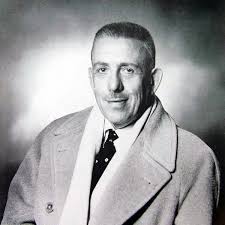
Francis Poulenc
Francis Poulenc knew all the all-time poets, setting the works of Apollinaire and Éluard once again and again. He set up the poets to opera (Les Mamelles de Tiresias), for a cappella choir, for voice and piano, in a secular cantata (Figure humaine), and then on. In fact, Poulenc once wrote "If one placed on my tomb the inscription 'Here lies Francis Poulenc, the musician of Apollinaire and Éluard,' I recall information technology would be the finest claim to fame."
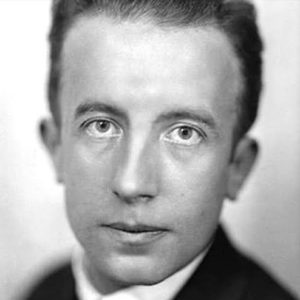
Paul Éluard
Paul Éluard (1895-1952) was not only a poet but besides 1 of the founders of the Surrealist move. Later on a difficult WWI, where he started by writing letters of condolence and ended equally a total soldier, he found a new life in the post-war era with a group of poets that include André Breton. Inspired by the Dadaist movement in France, he went to Cologne to run into its founder, Max Ernst. Migrating illegally to French republic, Ernst lived in a ménage à trois with Éluard and his wife Gala. Éluard finally fled and was located in Saigon. In 1928, his tuberculosis put him into a sanatorium and his married woman left him for Salvador Dalí, with whom she remained for the rest of her life. Éluard had a political life, joining and being banned from the French Communist party. During WWII his poem "Liberté' was parachuted in the thousands past English aircraft over occupied France, and at the finish of the war he was hailed every bit one of the swell poets of the Resistance.
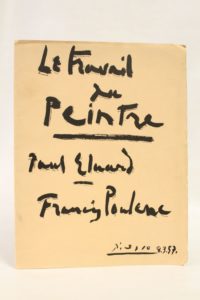
Poulenc'south Le travail du peintre first edition encompass, design by Picasso
In 1956, Poulenc set a group of vii poems under the title Le Travail du Peintre (The Painter'due south Piece of work) with each poem based on a separate painter. The poems come up from a diverseness of Éluard poems and collections, just had been renamed by Éluard for Poulenc's setting.
Le Travail du Peintre (translation)
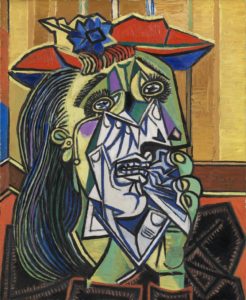
Picasso: Weeping Woman (1937) (Tate)
The first song, "Pablo Picasso," comes from long poem entitled 'Travail du peintre,' which had appeared in Éluard's Poésie ininterrompue of 1946. Poulenc only sets the first part of the poem. Picasso had the literal starting time place because he likewise designed the comprehend for this music.
The poem is full of colours: lemon yellow, white, black, azure and seems to describe Picasso's distinctive rapid drawing style, asking 'pourquoi pas' (why not) every bit one word is joined past another, a rima oris is similar a feather, smiles and tears join, all renounced past a 'single movement of the eyelids.'
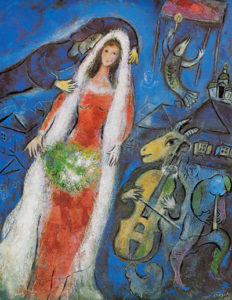
Chagall: La Mariée (1950) (Private Collection, Japan)
Poulenc: Le travail du peintre, FP 161: No. 1 Pablo Picasso (Pierre-Yves Pruvot, baritone; Charles Bouisset, pianoforte)
'Marc Chagall' follows, filled with the images of many Chagall paintings: animals, a singing bird, a violin, an active dancer and his wife.
No. two Marc Chagall
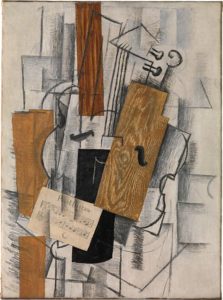
Braque: Violin and Sheet Music: "Petite Oiseau" (1913) (Metropolitan Museum of Art)
The poem 'Georges Braque' takes as its center a bird, flying away, without a shadow, flying into the light. It closes with 'a human with lite eyes' who describes 'the sky of beloved,' gathering in the wonders like birds in their wings.
No. 3 Georges Braque
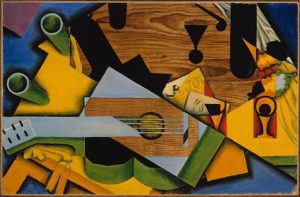
Gris: Notwithstanding Life with a Guitar (1913) (Metropolitan Museum of Art)
'Juan Gris' contrasts the day globe with the night globe – ane shows the merciless nowadays while the other is full of shadow. This is one of the best known of these 7 songs.
No. iv Juan Gris
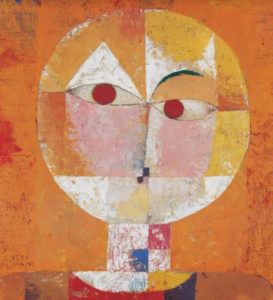
Klee: Senecio (1922)
Paul Klee, whose painting with lines and shapes seemed to reduce the complexity of life to understandable lines and colours, is fix to music that changes the tiresome texture we've heard and so far and makes it more than heroic, every bit though reading behind the images.
No. 5 Paul Klee
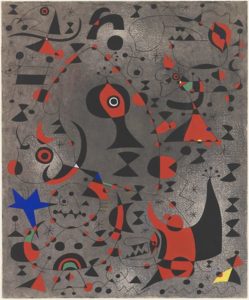
Miró: Constellation: Toward the Rainbow (1941)
(Metropolitan Museum of Art)
More abstract than Klee, Joan Miró created a world where shapes bladder in space, almost child-similar in their presentation, yet with an integral artful that draws united states into their surreal placement. Shapes move and shift, colours change, and in the verse Éluard keeps removing elements: remove the hill, the forest…all is dissipated with a wave of the creative person's hand.
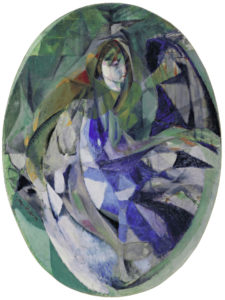
Villon, Girl at the Piano (Fillette au pianoforte) (1912) Museum of Modern Fine art, New York
No. vi Joan Miró
The cycles closes with Jacques Villon, perhaps the least familiar of the 7 artists. He was an older brother of the more famous Marcel Duchamp, and worked in a variety of styles at the turn of the century, including Fauve, Cubist, and abstract impressionism. He worked largely in Normandie, away from the Paris art eye in Montmartre, and information technology was his 1944 exhibition in Paris that brought him international recognition. Éluard's poem pushes forth Villon equally someone who has conquered all, despite all that got in the way.
No. seven. Jacques Villon
The poesy of Éluard in the hands of Poulenc has given us a unique view into the impressively artistic earth of art of 20th century Paris.
mitchellpultooper.blogspot.com
Source: https://interlude.hk/musicians-and-artists-poulenc-eluard-and-their-friends/
0 Response to "Poulencs Le Travail Du Paintre a Unification of Art Poetry and Music"
Postar um comentário